
|
|
I am thrilled to share that my article, “Creating Safety in Small Moments: Trauma-Informed Practice for Young Children,” has been published in the Fall 2025 Journal of Early Childhood Educators of British Columbia!
In this article, I explore how childhood trauma-whether visible or hidden-shapes children’s behaviors, learning, and emotional development. I also share practical strategies for creating supportive, trauma-informed environments where children feel safe, seen, and empowered. Drawing from my own experiences growing up in a war-affected environment, I offer a perspective on resilience, care, and the profound impact educators can have during a child’s most formative years. If you are an early childhood professional, I invite you to read the full article through the journal’s membership and join the ongoing conversation about trauma-informed care in early learning spaces. A special thank you to the ECEBC editorial team for their thoughtful guidance and support throughout the submission and publication process-your work helped bring this article to life. Read the full article through the ECEBC journal membership [here]. |
|
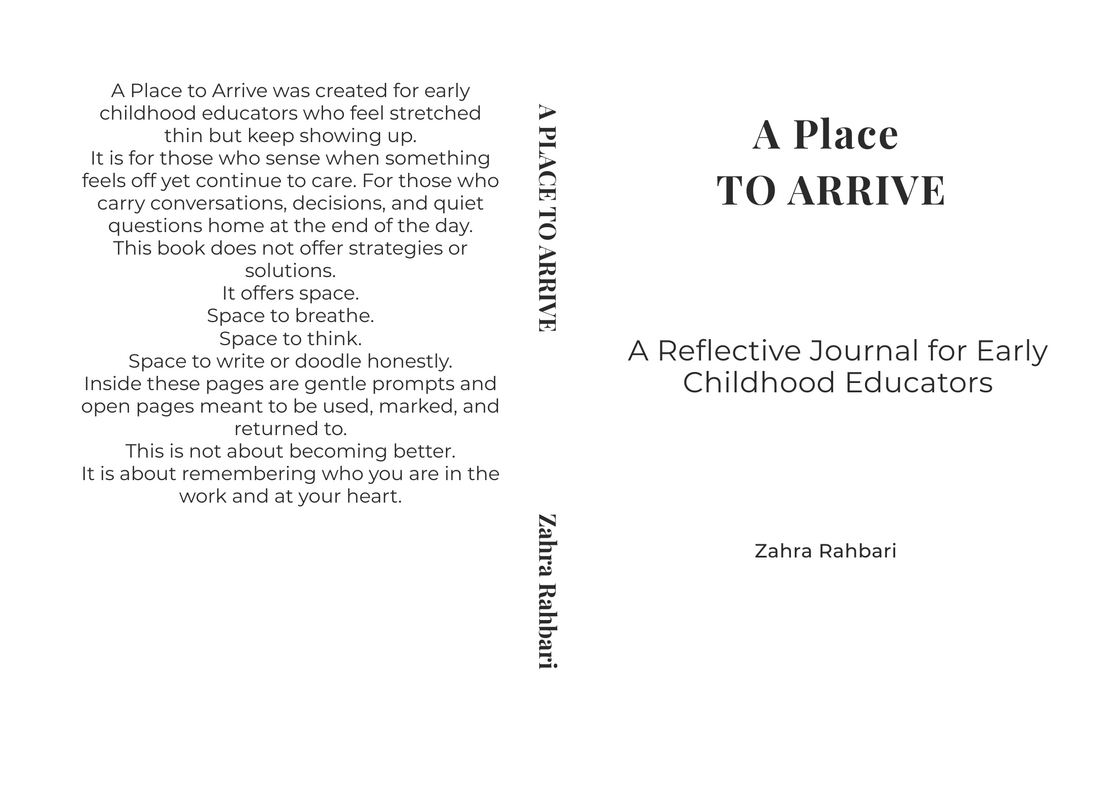
A Place to Arrive is a gentle invitation to pause in the middle of a fast and demanding day. Rooted in real experiences with children, families, and educators, this book offers small, meaningful moments to return to yourself.
Each page creates space to slow down, notice, and reflect. Through simple prompts, quiet observations, and soft invitations to draw or write, the book supports you in reconnecting with your thoughts, your body, and your role as an educator and caregiver. This is not a book to finish. It is a place to return to. A place where reflection is not about doing more, but about being present with what already exists. Designed for everyday use, A Place to Arrive supports emotional awareness, grounded practice, and a deeper connection to the moments that shape your work with children. It honours the reality that caring for others begins with caring for yourself. [View the Book Here!] |
|
|
Through this e-portfolio, I share a two-and-a-half-year journey in the Master of Education in Early Childhood Education at UBC.
At its heart is the metaphor the flower in the garden, each child unique, blossoming in their own time, nurtured by care, kindness, and the freedom to grow. This portfolio gathers reflections, artifacts, and learning goals that illustrate how educators can support individuality, cultivate empathy, and foster autonomy. Like a garden, early learning spaces flourish when every child is seen, valued, and allowed to bloom. It is both a record of my growth and an invitation-to explore, reflect, and celebrate the beauty of children thriving in their garden of learning. [View the Portfolio] |
|
|
I am fortunate enough to carry a piece of my earlier academic life with me. Alongside getting deeper in my research of the children's world, I completed a Master of Arts in English Translation. As a lifelong lover of reading and storytelling, I became fascinated with how children meet characters on the page, and how translation shapes that meeting.
My thesis explored this question through the world of the Harry Potter series, studying how young readers respond to translated versus original proper names. Proper names are identities without explanation, pure, simple, and whole. What I found was beautifully clear: children prefer the magic untouched. They gravitate toward names kept in their original form rather than names altered or “explained” in translation. It was an early lesson in trusting children’s capacity to make meaning, to imagine freely, and to connect with stories on their own terms-something that continues to shape my work with young learners today. [View the Summary here] |